The operator's software catches you overbilling. Nothing catches you underbilling.
We find the money your field tickets leave behind. Fuel surcharge left off. Standby nobody billed. Last year's rate on this year's job. Tickets that never got invoiced. It starts with a free leak audit.
Gulf Coast diesel was $5.91 a gallon in the week of November 2, 2026, up $2.54 on a year ago. If your fuel surcharge isn't on every invoice, that gap comes out of your margin. Source: EIA, Gulf Coast (PADD 3) on-highway diesel, weekly
Where the money leaks
None of these show up as a loss. The invoice goes out, the operator pays it, and the money that should have been on it is just gone.
Fuel surcharge left off
The clause is in the MSA. It never made it onto the invoice, or it went on at last quarter's rate.
Standby nobody billed
Wait time written in the box on the ticket, then never billed. Or cut because the rep never initialed it.
Last year's rate
The rate sheet changed in January. The crew's ticket book didn't.
Wrong truck tier
Work done with the 130 bbl truck, billed at the 80 bbl rate.
Miles with no mileage line
Loaded miles past the free zone, written on the ticket, never charged.
Helper hours missing
Two hands on the job, one on the invoice.
Call-out minimums skipped
A 90-minute job on a 3-hour minimum, billed at 90 minutes.
Tickets that never got invoiced
The job got done. The ticket sat in a truck, then a drawer.
Short pays nobody chased
The operator paid less than the invoice. Nobody had time to send the backup.
Kicked back for paperwork
No AFE number, no signature. The invoice comes back and the clock on getting paid starts again.
How it works
Three steps, and you can stop after any of them.
- 01
Free leak audit
A 20-minute call, or the questions answered in writing. Fuel, standby, tickets, getting paid. Every answer is a number. You get a one-page read back: your likely leaks, ranked by dollars, with the math shown.
See the questions - 02
Full leak audit
If the free read shows money worth chasing, we go line by line. Your MSAs and rate sheets, clause by clause, against six months of tickets and invoices. Dollars missed by customer and by month, the fix for each, and where the office hours go. Quoted after the free audit, credited to the build if you go ahead.
- 03
The build
We fix what the audit found so it stays fixed. Fuel surcharge on every invoice off the weekly diesel index. Standby captured and signed on location. Every ticket checked against the rate sheet before it goes out. A weekly page of what got recovered.
How Ticket-to-Cash works
See it catch one
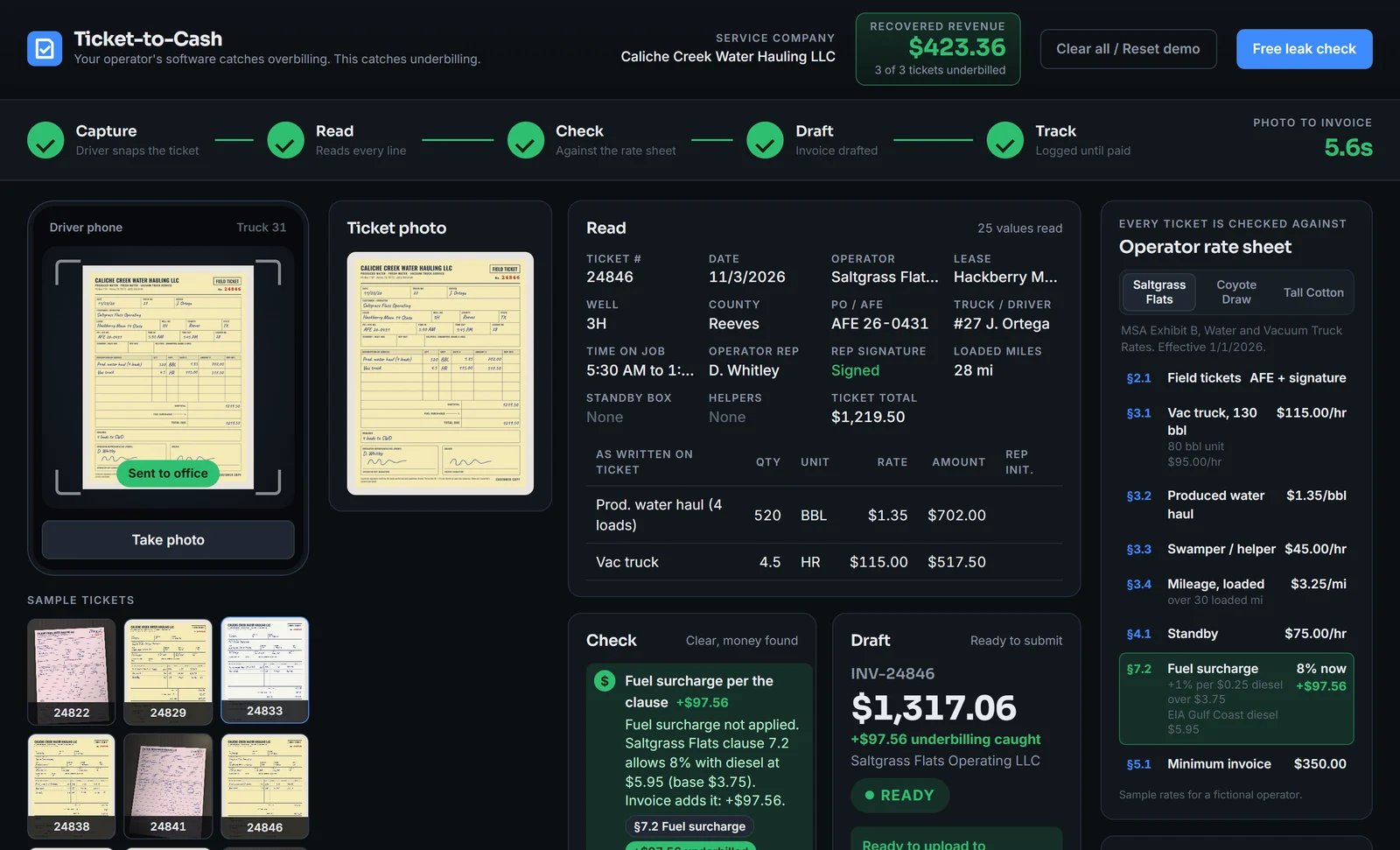
This is the Ticket-to-Cash demo running on sample tickets from made-up companies. A ticket goes in, gets checked against the operator's rate sheet, and the missed fuel surcharge goes back on the invoice before it's sent. Try it yourself, it runs in your browser.

Beyond billing
The audit also shows where the office loses hours. Hours are money too. These are the jobs we take off your plate when the audit says they're worth it, and only then.
Driver paperwork that expires
Medical cards, CDLs, drug tests, COIs, H2S and SafeLand cards. An alert before the date, not after the roadside inspection.
Payroll against the tickets
Driver hours matched to tickets and the ELD before payday, so the paycheck and the invoice agree.
New operator packets
The insurance, W-9 and safety documents every new operator asks for, kept current and ready to send.
Retyping between systems
Tickets, rates and timesheets typed from one place into another. We find where it happens and take it out.
Questions owners ask
Who is this for?
Owner-run oilfield service shops in the Permian, roughly 10 to 60 trucks. Water hauling, vac trucks, roustabout crews, hot shot. If you bill off a rate sheet and the tickets still come in from the field, the leaks on this page apply.
Is the free leak audit really free?
Yes. A call and a one-page read back. No card, no contract. If it shows money worth chasing, we quote the full audit. If it doesn't, we tell you that.
Do I need new software for the audit?
No. The free audit is a conversation. The full audit works from what you already have: rate sheets, MSAs, tickets and invoices, on paper or as PDFs.
Who sees our rates?
Rate sheets and tickets you send are used for your audit and nothing else. They never go to your customers or to other shops.
Don't the operators already check the invoices?
They check for overbilling. Price books, matching rules and portal checks all exist to stop you charging too much. Nothing on their side flags a surcharge you forgot, standby you didn't bill or last year's rate. That's the side we check.